 AI Scribe Reviews
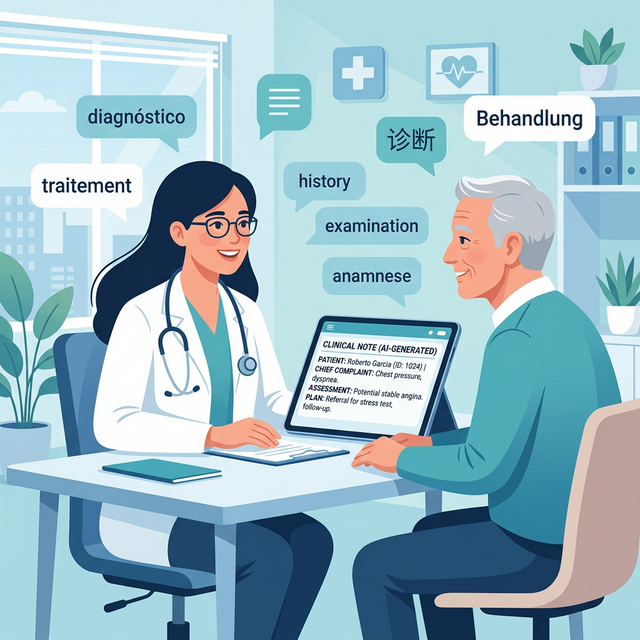
Breaking the Language Barrier: Why Multilingual Support is the Next Frontier for AI Medical Scribes
“She kept saying dolor de pecho, and I knew exactly what she meant, but the note had to be in English. By the time I finished translating, documenting, and coding, I’d lost fifteen minutes I could have spent with my next patient.”
That’s a family medicine physician in Houston describing a routine Tuesday. For clinicians serving diverse communities, this scenario plays out dozens of times a day—and it represents one of the most significant remaining friction points in clinical documentation.
The Scale of the Problem
The numbers are staggering. Over 25 million people in the United States have limited English proficiency (LEP), according to the U.S. Census Bureau. In states like California, Texas, and New York, LEP patients can represent 20–40% of a clinic’s panel.
The health consequences of language barriers are well-documented and severe:
- LEP patients experience a 30% higher rate of harmful events during hospitalization compared to English-proficient patients
- 34% of LEP adults report their physical health as “fair” or “poor,” versus 19% of English-proficient adults
- LEP patients are significantly less likely to receive preventive care, including cancer screenings
- During the COVID-19 pandemic, LEP individuals were three times more likely to test positive and, if hospitalized, 35% more likely to suffer serious outcomes
- The uninsured rate among LEP adults is 33%, compared to 7% for English-proficient adults
These aren’t just statistics—they represent a systemic failure to meet patients where they are. And while professional medical interpreters help (their use has tripled from 8.3% to 34.9% of patient encounters between 2011 and 2023), fewer than half of LEP patients currently have access to one.
Why Traditional Documentation Fails Multilingual Encounters
For clinicians working with diverse patient populations, the documentation burden is effectively doubled. They must capture the clinical nuances of the visit while simultaneously navigating translation and cultural context—often switching between languages mid-sentence.
Traditional AI scribes, built primarily on English-centric models, frequently fail in these settings:
- They misrecognize non-English medical terms or drug names
- They struggle with accented speech or code-switching (alternating between languages)
- They produce garbled transcriptions when the conversation isn’t in English
- They add latency by routing audio through secondary translation layers
This forces clinicians back into manual note-taking—defeating the purpose of adopting AI in the first place—and disproportionately affects the patients who already face the greatest barriers to care.
Where the Major AI Scribes Stand on Multilingual Support
The good news: multilingual capability has rapidly become a priority across the industry. But the depth and maturity of support varies significantly. Here’s where the major platforms stand today.
Nuance DAX Copilot
Microsoft-backed Nuance DAX supports 40+ languages and dialects. Their strongest non-English support is in Spanish, where DAX Copilot can transcribe clinician-patient conversations conducted entirely in Spanish or in a mix of English and Spanish. Each speaker’s portion is transcribed in the language spoken, though AI-generated clinical summaries are produced in English.
Spanish recording mode is available through DAX Copilot for Epic via the Haiku and Canto mobile apps. Microsoft’s continued investment in AI language models—with major release waves planned through 2026—suggests broader language support is on the roadmap.
Strengths: Deep Epic integration, strong Spanish support, Microsoft’s AI infrastructure backing future expansion.
Limitations: Non-Spanish languages are less mature; requires specific “language packs” that may add complexity.
Abridge
Abridge takes a validated-first approach, with 28 languages validated for clinical use, including the 16 most widely spoken in the United States. A key differentiator: Abridge automatically detects the language being spoken, eliminating the need for clinicians to pre-select a language before the encounter.
The system handles code-switching well—conversations where participants alternate between languages—and generates English clinical notes from multilingual conversations. Supported languages include Spanish, Mandarin, and Haitian Creole.
Strengths: Auto-detection removes workflow friction; validated (not just “supported”) across 28 languages; strong code-switching handling.
Limitations: Smaller language count than some competitors; focused on U.S. market languages.
Suki
Suki offers the broadest multilingual support among the major enterprise platforms, covering 80+ languages. The system automatically detects the spoken language, transcribes in that language, translates, and generates the clinical note in English—all without clinician intervention.
A standout feature: Suki can generate multilingual patient instructions in all 80+ supported languages at a fifth-grade reading level. This directly addresses a critical gap—LEP patients often struggle to understand discharge instructions even when the encounter itself went well.
Strengths: Widest validated language count; multilingual patient instructions; voice command support in multiple languages.
Limitations: Enterprise-focused pricing may be prohibitive for smaller practices.
Freed
Freed claims the largest raw language count at 90+ languages. The platform supports code-switching within a single visit and generates chart-ready clinical notes in English. Patient-facing instructions are kept in the language spoken during the encounter.
Freed emphasizes accent recognition and clinical terminology accuracy across its supported languages, which is critical for avoiding the kind of transcription errors that can have clinical consequences.
Strengths: Largest language count; strong accent recognition; patient instructions in source language; widely available on mobile.
Limitations: Less transparency on which languages are “validated” vs. “supported” in beta.
Nabla
Nabla supports 35 languages, with a notable focus on clinical accuracy. Their rollout has been methodical—beta testing each language before full release. Providers select the patient’s preferred language before starting the AI note-taking assistant, and patients receive summaries and follow-up instructions in their chosen language.
An interesting data point: in some U.S. states, up to 14% of Nabla doctor consultation notes use the Spanish language option, suggesting meaningful real-world adoption rather than just checkbox feature support.
Strengths: Methodical validation approach; patient-facing summaries in preferred language; strong real-world adoption metrics.
Limitations: Smaller language count; requires pre-selection of language (no auto-detection).
DeepScribe
DeepScribe commercially supports English and Spanish, with an additional 50+ languages available in beta through their multilingual program. The system handles code-switching and generates English clinical notes from multilingual conversations.
Strengths: Strong English-Spanish commercial support; broad beta program for evaluation.
Limitations: Most languages remain in beta; limited compared to competitors who have formally validated broader language sets.
Medical Scribe
Medical Scribe supports 57 languages natively, with speech-to-text models specifically trained on medical terminology across all supported languages. Unlike platforms that route non-English audio through a generic translation layer, Medical Scribe processes each language with dedicated models—meaning drug names and complex diagnoses are captured accurately whether the conversation is in Spanish, French, Mandarin, or any of the other 54 supported languages.
A key differentiator is instant processing: regardless of the language spoken, EMR-ready SOAP notes are generated without translation lag. The platform works across iPhone, Apple Watch, Mac, Android, and the web—making it one of the most accessible options for multilingual practices regardless of device preference.
Strengths: 57 natively supported languages with medical-specific STT models; no translation lag; available across all major platforms (iPhone, Apple Watch, Mac, Android, web).
Limitations: Newer entrant compared to legacy platforms like Nuance DAX.
Comparing Multilingual Capabilities at a Glance
| Platform | Languages | Auto-Detect | Code-Switching | Patient Instructions | Notes Language |
|---|---|---|---|---|---|
| Nuance DAX | 40+ | No | Yes (Spanish) | No | English |
| Abridge | 28 (validated) | Yes | Yes | No | English |
| Suki | 80+ | Yes | Yes | 80+ languages | English |
| Freed | 90+ | Yes | Yes | Source language | English |
| Nabla | 35 | No (pre-select) | Yes | Preferred language | English |
| DeepScribe | 50+ (mostly beta) | Yes | Yes | No | English |
| Medical Scribe | 57 | Yes | Yes | No | English |
What to Look for When Evaluating Multilingual Support
Not all “multilingual support” is created equal. When evaluating platforms for a diverse practice, ask these questions:
-
Validated or just supported? There’s a meaningful difference between a language that has been clinically validated and one that technically works but hasn’t been tested with real medical terminology.
-
How does it handle code-switching? In real clinical encounters, patients frequently switch between languages. A system that requires monolingual conversations is impractical.
-
What about medical terminology? Can the system accurately capture drug names, diagnoses, and procedures in non-English languages? A generic translation layer won’t cut it for clinical documentation.
-
Does it produce patient-facing materials? Generating the clinical note in English is table stakes. The best systems also produce patient instructions and after-visit summaries in the patient’s preferred language.
-
What’s the workflow impact? Does the clinician need to pre-select a language, or does the system auto-detect? Small friction points add up across dozens of encounters per day.
The Regulatory Landscape
It’s worth noting that multilingual support isn’t just a convenience—it’s increasingly a compliance requirement. Under Title VI of the Civil Rights Act and Section 1557 of the Affordable Care Act, healthcare organizations receiving federal funding must provide meaningful access to LEP individuals. While AI scribes don’t replace the need for qualified interpreters, multilingual documentation tools can significantly reduce the secondary burden of translating and re-documenting encounters.
The Future Is Multilingual
The trajectory is clear: multilingual support in AI medical scribes is moving from “nice-to-have” to “essential.” As these tools mature, we should expect to see:
- Deeper specialty-specific language models trained on medical terminology in each supported language
- Real-time translation overlays that help clinicians and patients communicate during the encounter itself
- Regulatory-grade validation across broader language sets, not just beta support
- Multilingual clinical decision support that draws on non-English medical literature
For practices serving diverse communities, the ability to document accurately across languages isn’t just about efficiency—it’s about equity. The best AI scribes are the ones that work for all of your patients, not just the ones who speak English.
Medical Scribe supports 57 languages with instant processing across iPhone, Apple Watch, and Mac. See how it works in your multilingual practice.